
I am a painter working with floral forms as a language to explore human emotions, fragility and connection. Through color and contrast, I reflect on inner experience, memory and the subtle transformations that shape who we are.
Dubai, United Arab Emirates
@darinakomorowski | darinakomorowski.tilda.ws
INTERVIEW
How did you find your way into art – was there a specific moment or person that set you on this path?
I remember my first painting teacher when I was three. I remember the paint on her hands, and I remember that even then I already understood what I wanted. There was this feeling that you are in your place, and also this feeling that the paint will stay with you forever. That these are my hands. You look at your hands and it’s as if you recognize something.
I don’t know if such personal things are always interesting to tell, but I think I was also filling a kind of missing part of my mother’s own story.
Maybe when she was little she wanted to draw, to sing, to play, and when I appeared she gave me all of that. She allowed me to live in a world where we don’t choose only what is necessary, but we choose what is interesting, what is engaging, what I wanted. That’s how painting opened itself to me.
And honestly, I believe art should be part of everyone’s life. It doesn’t matter what form it takes. Maybe you paint cups, maybe you lay tiles, maybe you arrange a carrot beautifully on a plate, maybe you just approach cooking with taste. For me it’s all about respect for your own soul.
How would you describe your artistic practice to someone encountering your work for the first time?
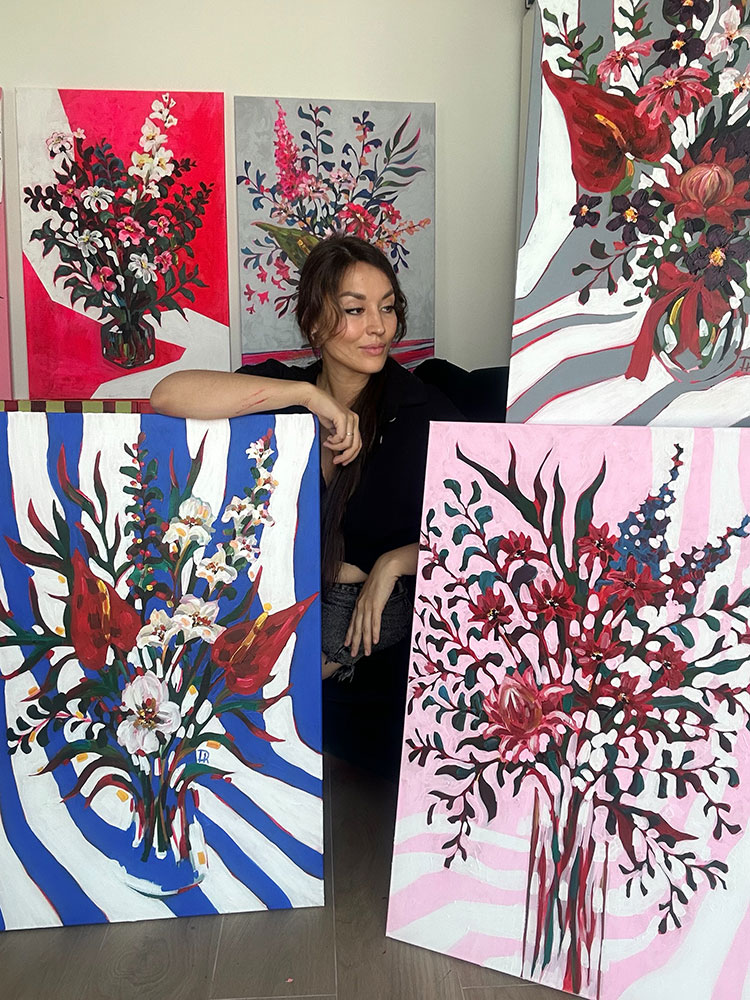
If someone sees my work for the first time, I would start with what the floral motifs mean for me. Flora is not decoration. I read it as a natural, living quality of the human soul, a reminder that a person is already who they are, and that this deserves deep respect. Even if you are moving toward something better, the first step is to respect who you are right now.
This is why I speak about permission and acceptance. Not moving through a whip, but moving through allowance. Through gratitude. Through a calm yes to your own nature.
When I say I paint flowers, I mean something very simple and very demanding at once. I want a person to treat themselves as something natural, something important, something valuable. With attention. Attention does not mean indulgence. It means relating to yourself the way a good parent relates to a child. Not the one who scolds and breaks you, but the one who can offer a shoulder, direction, and care.
What themes or ideas keep returning to your work, even when you don’t plan for them?
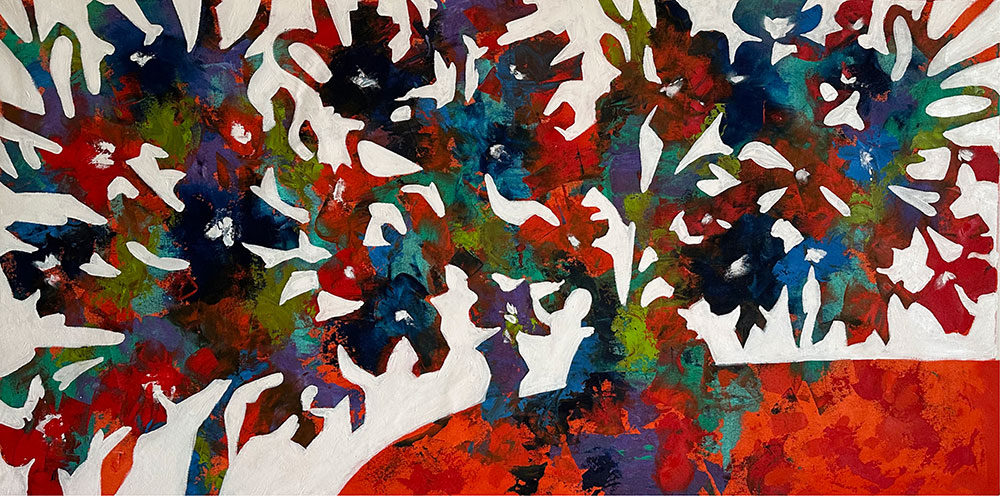
If we talk about motifs, flora keeps returning. If we talk about ideas, it feels like I’m writing about souls. For me painting has always been an emotional transformation of my own feelings. I remember that раньше, when I had misunderstandings with someone, I would simply sit down and paint their portrait. It was like sending love through the portrait. Even if at first you are angry and you press the pencil too hard, in the end something changes.
The main story in my paintings is human love, a deep value of life around you, and it starts from yourself. It is easy to feel sorry for someone far away, to love a distant image, but my focus is on something more everyday and more difficult. An absence of competition. Accepting others as they are. Allowing the world to be the way it is. Allowing yourself to be the way you are.
So my paintings are mostly about naturalness, permitted naturalness, and importance. About learning to value life again and again.
Can you walk us through your process – from the first idea to a finished piece?
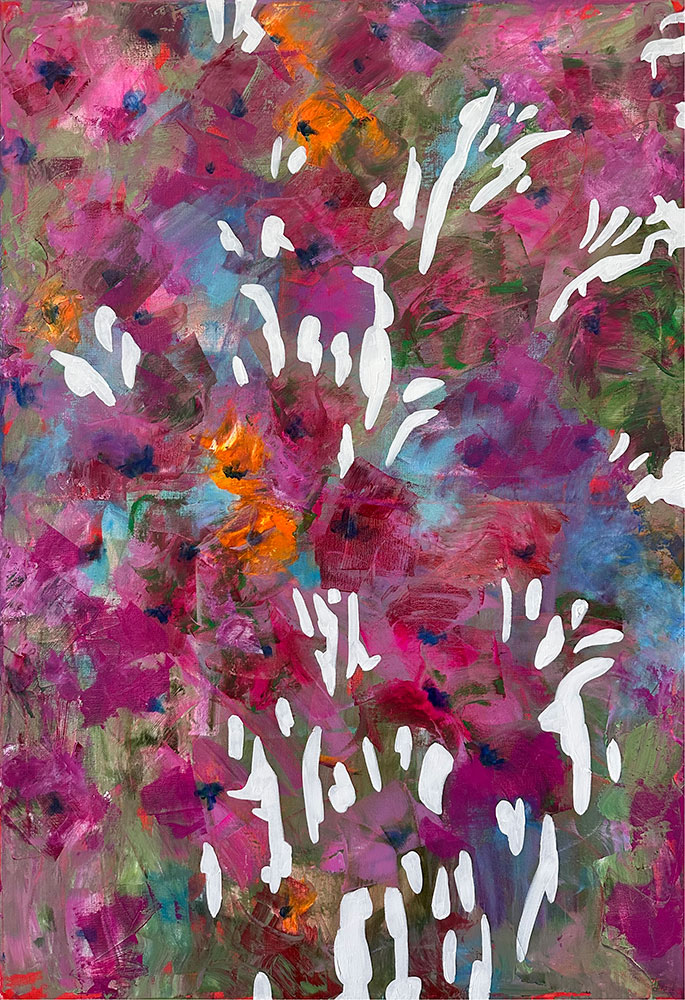
My process is not a straight line from an idea to a plan. Often a motif appears somewhere almost casually. It keeps showing up in sketches or in the corner of a composition, and only later I understand why it stays with me. Sometimes it becomes something the figure holds in their hands. When that happens, the whole image starts organizing itself around that gesture, around what is being carried, protected, offered, or simply held.
I work through returning and noticing what repeats. I let the painting explain what it wants to become instead of forcing it into a “correct” solution too early. I build the piece by testing variations. I change the scale, shift the placement, simplify the surrounding space, and watch what becomes clearer. If something feels decorative, I ask what it is actually saying. If it feels heavy, I search for air. If it feels empty, I look for the exact element that makes the meaning land.
I also pay attention to how the motif behaves emotionally. A repeated form can be about tenderness, about distance, about care, about the need to hold something close. When I feel that the image has found its inner logic, I start refining the structure.
What are you currently working on, and are there any upcoming exhibitions or projects you’d like to share?
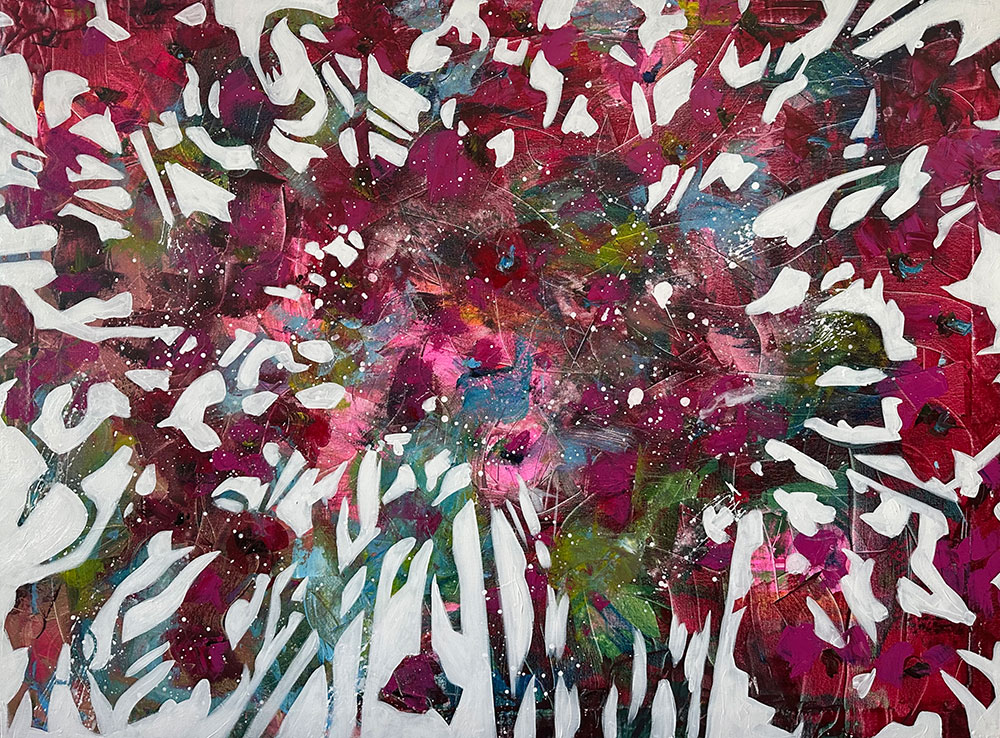
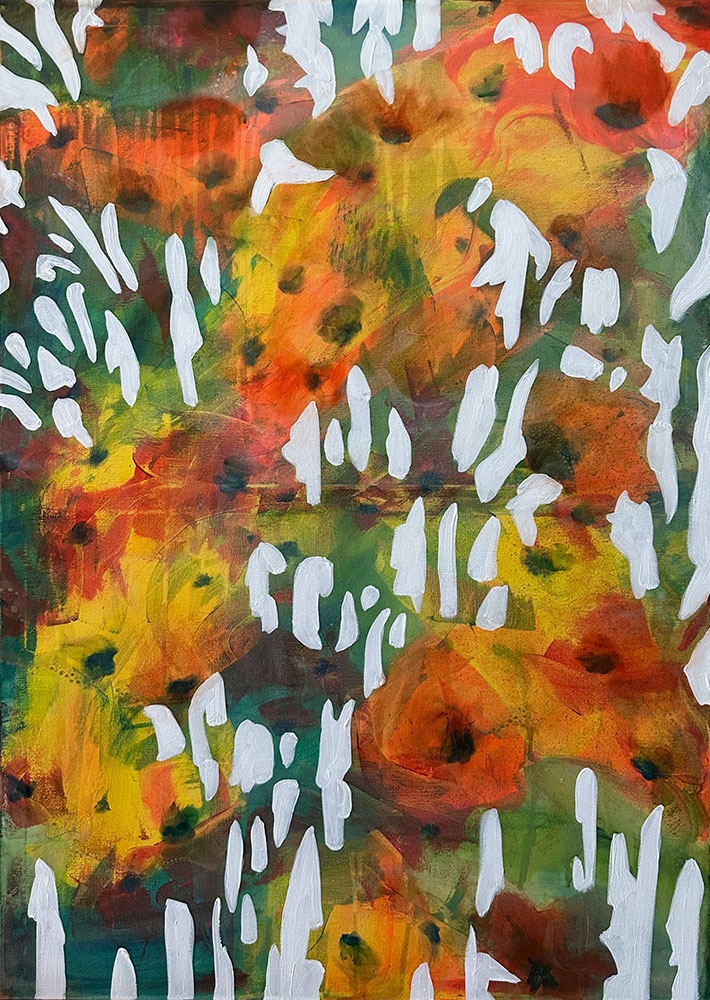
Right now I’m working on my golden series. Earlier I treated the background around my flowers almost like a social field, a reminder of what surrounds us. In this series, the flower in my painting feels less like a flower and more like a continuation of a person. It points to the naturalness of our needs, physical, emotional, and mental, including the need to dream, the need to allow ourselves, the need to express, the need to create. The more a person accepts themselves, the more clearly these layers of need can be felt.
The newest works are paintings that live next to gold. For me, gold carries a sense of infinity and a deep respect for what surrounds you, and for what cannot be priced. I once read about “gradations of love”, moving from control and abuse, to sacrifice and obligation, and then toward the highest form, love as acceptance, unconditional love, devoted love. That idea stays with me, and it connects to why I return to gold.
How has your practice evolved over the years – what has changed, and what has stayed the same?
Over the last year, my practice has changed mostly through what I stopped doing to myself. When you grow up inside a conservative, academic environment, you start doubting everything: is this allowed, is that correct, do I have the “right” to do it at all. It can create a strange trap where you either stop painting altogether or you start copying what is already accepted, just to be seen as “proper.” I’ve been moving away from that mindset. I’m learning to allow myself more.
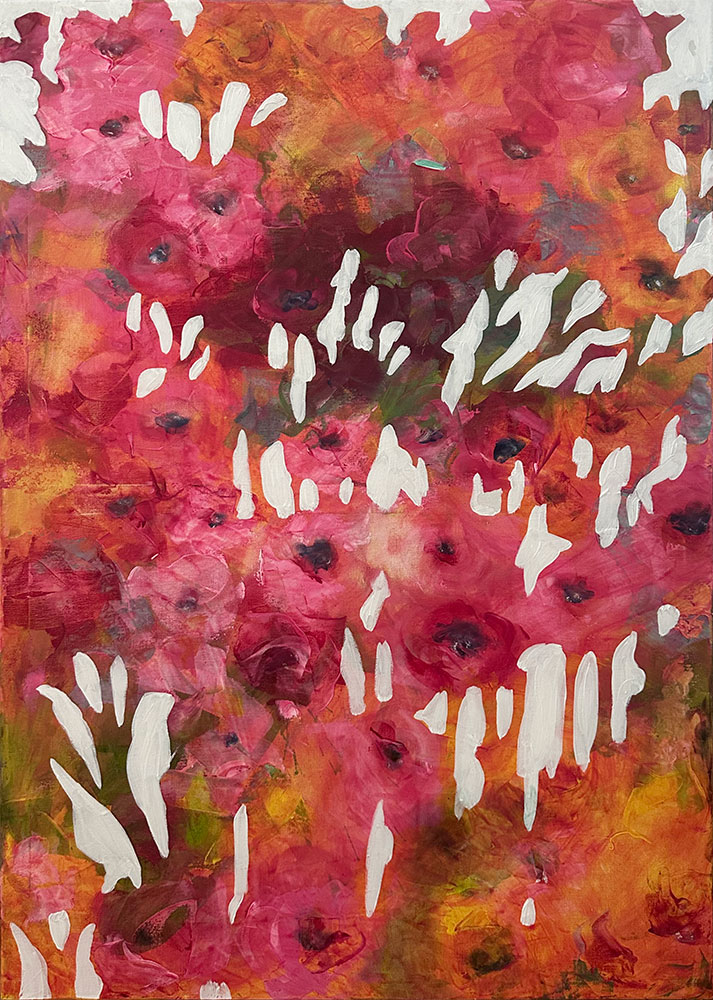
What stayed the same is my visual world. I used to work more in watercolor, and the motifs have been consistent for a long time: leaves, plants, flowers, branches, fruit. I’m drawn to elegant flexibility, branches between branches, shadows falling, the play of light. These stories keep inspiring me.
I also notice constants in the way I build an image. There is geometry in my works, a pull toward clear edges, toward areas of white and black, toward flat solutions. Diagonal compositions have been with me for years. I don’t enjoy painting a literal scene like a vase in front, a window behind, a garden outside. I prefer when the space stays more 2D, more concentrated on the surface.
What advice would you give to emerging artists just starting out, looking back on your own journey?
First, get clear on what you want in life. If the purpose of your life is art, ask yourself how much your dream costs, what you are ready to do for it, and start living as if it is already your direction. Set a goal, move toward it, keep trying, keep testing.
It feels truly important to make the process of art joyful. Keep it light enough to stay alive. Treat your inner desires with respect as they appear, allow yourself to try things, and give yourself permission to dream of an abundant world.
If everything were possible, what would you want from art? Let that question open the scale.
When you want someone to value your art, start valuing it yourself. Treat it with respect, choose good and interesting materials, keep exploring, and make the process engaging for you.
Also, keep balance. Build a rhythm where work and rest support each other, where your body and attention stay cared for, so the practice can last and deepen.