
I paint faces, landscapes, and skies as traces of lived experience.
Born: Sigmaringen, Germany
Now: Bad Schussenried, Germany
@roheauthenticart | rohauthenticart.de
Critical Review
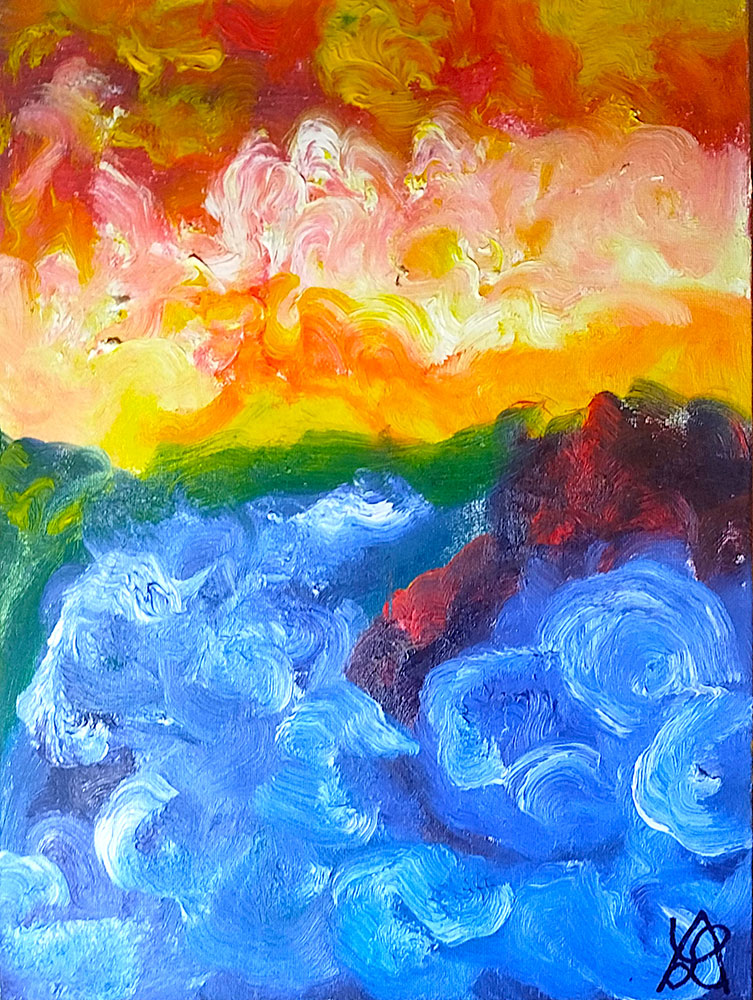
Lisa Angela Buchholz paints what consciousness feels like before it finds its name. Her “Inner Landscapes” series does not depict weather – it uses weather as the only honest language for states that resist description: the pressure before a storm, the quality of light when it has not yet decided whether to hold. These are qualia in oil – private textures of experience made visible not through illustration but through the logic of paint itself.
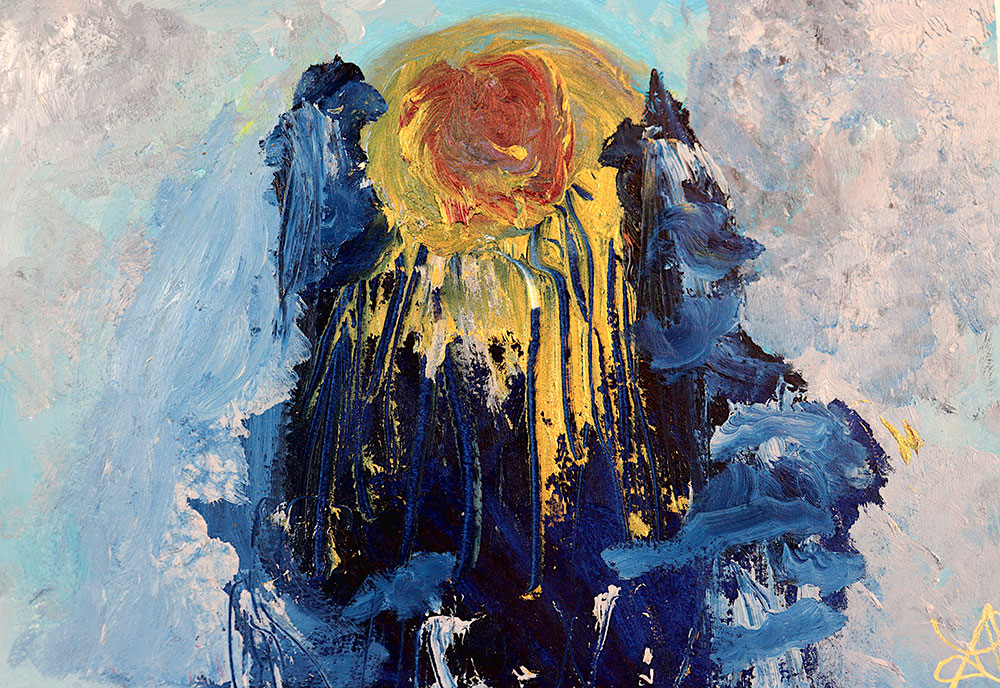
The works are small in format and uncompromising in density. Blue is never simply blue: it is orientation under pressure, the temperature of something trying to stay coherent in unstable conditions. The dissolving suns and fractured mountains that recur across the series function as fixed points that persist precisely because everything around them refuses to.
What distinguishes this practice is the refusal to choose between seriousness and absurdity. Buchholz draws on Adams and Pratchett with the same rigour she applies to philosophy of mind – not because she mistakes comedy for lightness, but because she understands that the grotesque and the cosmological have always described the same territory. The result is a body of work that asks viewers not to interpret weather, but to briefly inhabit it – and to leave slightly less afraid of their own.
Anna Ponomarenko, Editor
INTERVIEW
“Inner Landscapes” translates qualia – those private, unshareable textures of experience – into weather and terrain. At what point did you realise that storms and dissolving suns could carry what language cannot? Was there a specific painting where that shift happened?
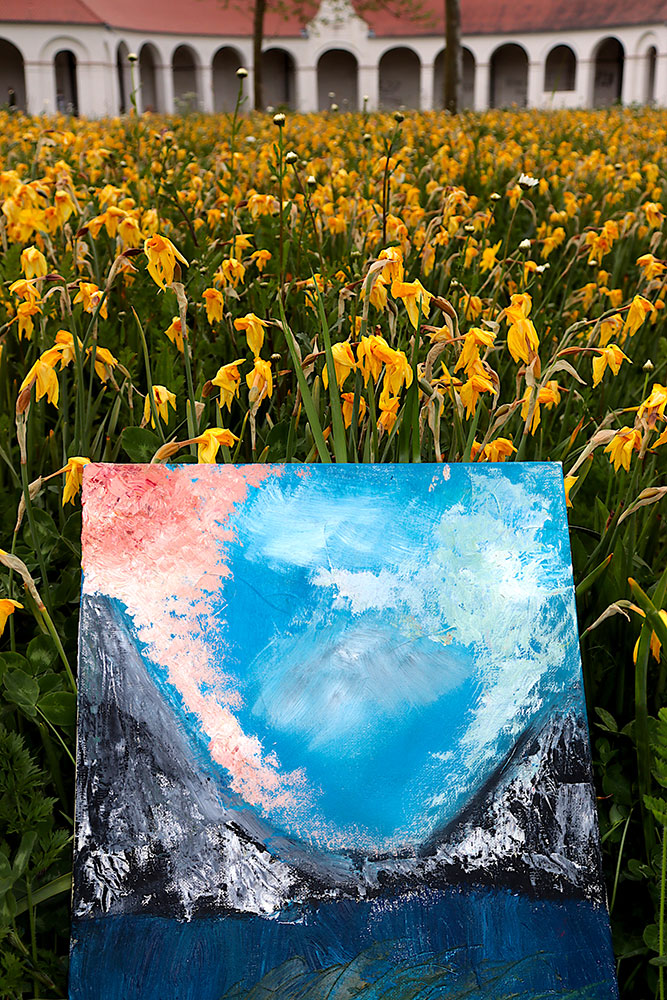
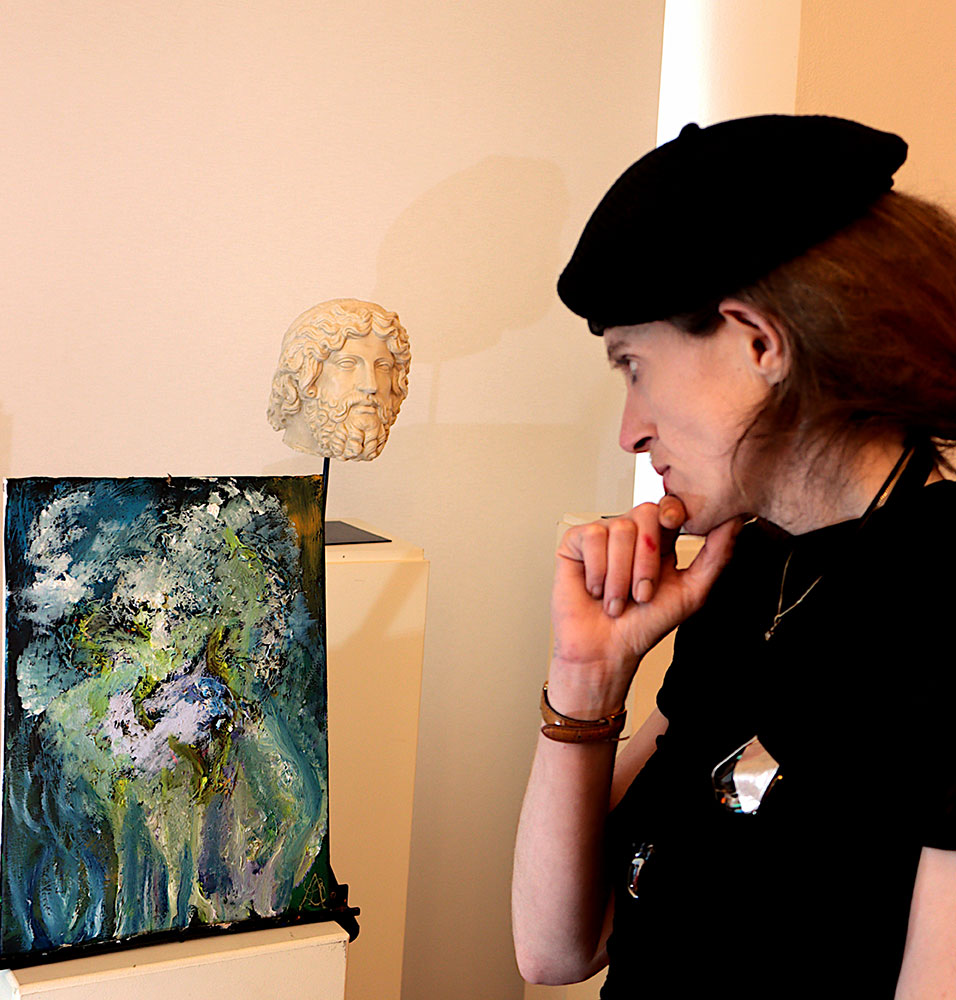
I suspect that this shift began with a particular painting: the azure-blue waves beneath an amber-red glowing sky in my series Inner Landscapes. It was there that I first realized I was no longer painting weather or landscape alone, but inner states. The Stanford Encyclopedia illustrates qualia through the viewing of a painting: one perceives not only what is represented, but also color, form, and spatial relations as modes in which seeing itself appears. In that sense, the blue of the waves and the glowing sky are, for me, carriers of experiential quality. A second time, this became clear while painting a cloud image: the gray of the cloud became a qualia-moment because it was no longer merely color, but a non-transferable way of appearing. At the same time, an almost pareidolic, face-like apparition emerged on the canvas. The painting thus preserves not only weather, but the transformation of an external phenomenon into experience.
You describe your figures and landscapes as carrying an inner life that is “simultaneously comic and cosmological.” That is an unusual pairing for painting that takes consciousness seriously. How do Adams, Pratchett and Moers actually work on you when you are in the studio – do they change what you allow yourself to paint?
Adams, Pratchett, and Moers change less what I paint in the studio than how far I allow the painting itself to think. They sharpen my perception of how grotesque and unstable the so-called normal already is. Their writing does not lead me toward caricature; rather, it opens a space in which comedy and cosmological unease can work together. What begins as a still relatively controlled thought can dissolve in the painting process into color, gesture, and contradiction. The comic then appears in exaggerations, failed intentions, and small absurdities, but it never remains a mere effect. It points instead to a consciousness that is not self-contained, but entangled with fantasy, narrative, projection, and deception. This is where their influence meets my interest in the philosophy of mind: I want the paintings to prompt the viewer to reflect on perception, consciousness, and the instability of what seems self-evident. The titles are part of this as well: they are not meant to fix the gaze, but to set it in motion again.
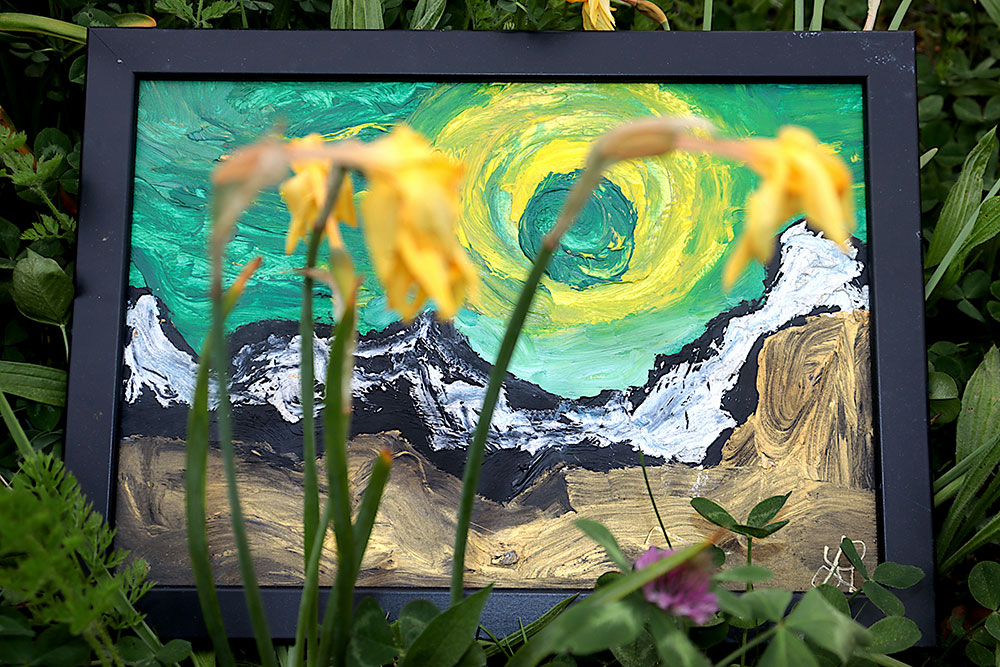
One painting in the series carries a quiet reference to Max Ernst – fractured stone, hidden suns, gold splintering like hair. You describe the connection as deliberately open rather than a homage. What does it feel like to work in the proximity of another painter’s visionary world without wanting to name it directly?
Working in proximity to another painter’s visionary world without naming it explicitly feels, to me, both stimulating and precarious. It is like entering a pictorial field of tension that sharpens perception while resisting closure. What matters to me is not homage, but a productive nearness to an image-world in which meanings remain open and forms seem to think beyond intention. Broken rock, hidden suns, or golden strands therefore appear not as quotations, but as formal carriers of pictorial thought at the threshold between memory, projection, and internal logic. What interests me is that the image preserves a surplus that cannot be fully conceptually contained. Its autonomy lies precisely there: the composition is set, but its symbolic charge remains open. The title, too, does not function as a label, but as a threshold that keeps the image open to further associations.
The series consists of small-format works. For a subject as vast as orientation and disorientation in unstable times, that is a choice that carries weight. What does the small format demand of both the painting and the viewer that a larger scale could not?
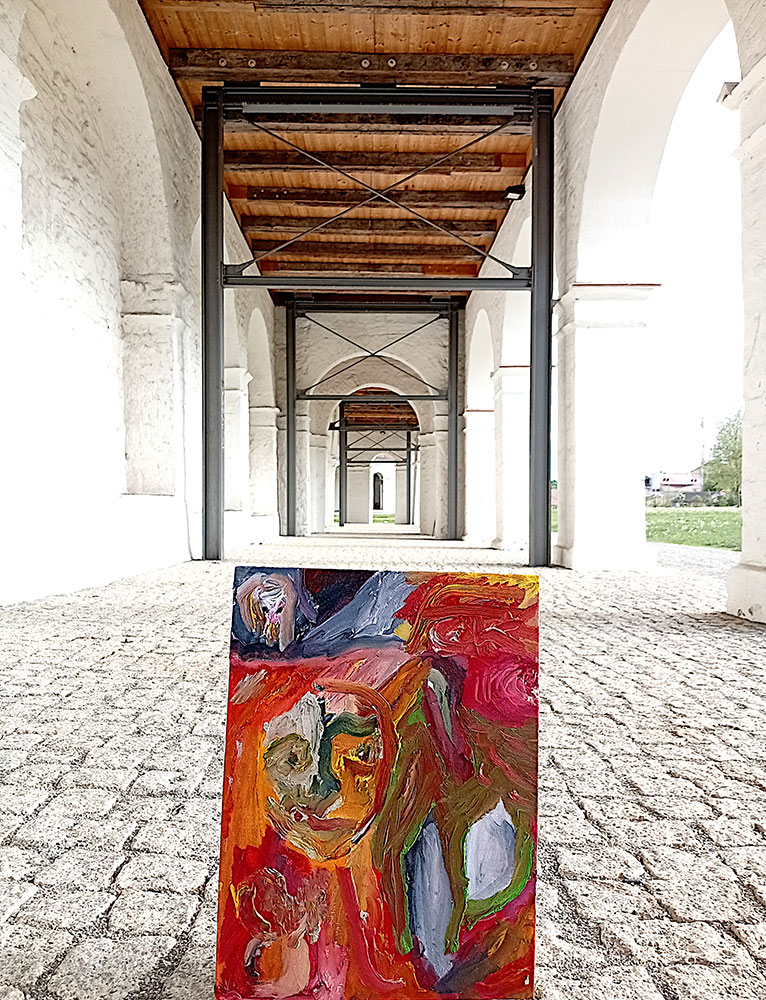
The small format is, for me, a quiet counterproposal to a present in which size is too easily mistaken for significance. It resists spectacle and replaces it with condensation: every centimeter must carry necessity, every line must have weight. For the painting, this means compression instead of expansion, density instead of extension. The surface becomes a field of heightened sensitivity. At the same time, the format shifts the viewer’s position: these works cannot be grasped casually from a distance; one has to come closer, slow down, and submit to a more attentive mode of seeing. Small does not mean slight in its effect. Through dense, expressive layers of paint, also in dialogue with CoBrA, I try to create pictorial tension and dimension within a confined space. What interests me is not monumentality but intensity: a painting that does not gain attention through size, but invites the viewer into a slower act of seeing.
Your practice is self-directed – art history, philosophy of mind, psychology, literature – rather than built through formal art education. How does that shape the way you work through a conceptual problem in paint? Is the research separate from the studio, or does it happen simultaneously?
Because my approach to painting developed in a self-directed way, I do not approach conceptual questions along an institutionally prescribed path, but through an ongoing movement between reading, thinking, painting, and listening. For me, philosophy, literature, and psychology do not stand outside the studio as preparatory knowledge; they remain present during the work and change their form. Music is often part of that
process as well, because it can shift a thought into rhythm, tension, or mood before it becomes image. When a question of consciousness, responsibility, or orientation arises, I may read a passage or search for a concept and then return to the canvas to see whether thought can continue in color, structure, or gesture.
Thinking does not stop in the process; it merely changes its medium. I do not want to resolve a problem
conceptually before I begin to paint.
The painting itself becomes a site of inquiry, where concepts meet resistance, pass over into perception, or return in altered form. Perhaps this is precisely where the freedom of this self-directed way of working lies: the studio becomes a space in which thoughts pass over into experience.
You write that painting saved you – not metaphorically. That kind of statement is rare in an artist statement because it risks sounding like testimony rather than position. What made you willing to say it publicly, and does the work itself need to carry that weight, or does it stand apart from it?
I was ready to say this publicly because, for me, it is not a dramatic slogan, but a precise description of necessity. The sentence names the condition out of which the work emerged: painting gave a state of inner pressure form, rhythm, and a future. But I do not want it to function as testimony that asks for belief, or as a moral shield around the work. The paintings do not have to prove this statement. If they did, they would risk becoming illustrations of biography rather than autonomous works. What they should carry is something else: the pressure, seriousness, and openness that arose from that necessity. In this sense, the sentence belongs to the origin of the work, not to its final meaning. The work should stand on its own for a viewer who knows nothing about me, while still bearing the mark of having emerged from urgency rather than distance. Painting saved me because I had too much to absorb and too much to endure, until expressive painting became the form in which all of this could finally be released. It was then that I understood, for the first time, that I am an artist. This is not a confession, but a consciously articulated artistic position.
The series proposes landscape as “a psychic and metaphysical field.” What would it mean for that proposal to succeed – what would a viewer need to experience in front of the work for you to feel the paintings had done what you intended?
For this proposition to succeed, a viewer would have to experience landscape not merely as place or mood, but as a field in which perception itself becomes at once less certain and more alert. Psychologically, much would already be achieved if the painting triggered a brief interruption of habit: if color, weather, and form no longer appeared simply as description, but as carriers of memory, tension, and expectation. Painting cannot undo the pressures of everyday life, but it can suspend the automatised gaze for a moment.
Metaphysically, what interests me is that the painting suggests an experience in which consciousness appears not as a closed inner sphere, but as open, permeable, and not entirely self-contained.
If that succeeds, the viewer does not simply search for meaning, but is thrown back upon their own perception and begins to reflect on it.
The work would have fulfilled its intention if one left the room not with an answer, but with the sense that seeing itself had, for a moment, become both questionable and alive.