
I’m a London-based multidisciplinary and mixed-media artist working across image, movement, and space. Through photography, installation, moving image, and spatial storytelling, I explore memory and displacement as part of contemporary experience, creating works where meaning unfolds through atmosphere, presence, and connection.
London, United Kingdom
@and.wherever | andwherever.space
Critical Review
Mohsen Saeb’s practice moves through a persistent question – not “who am I” as a statement to be made, but as a condition to be tested against distance, objects, and space.
Working across photography, installation, moving image, and performance, his practice holds an ongoing tension between presence and absence, nearness and rupture – a tension shaped as much by the experience of moving between Tehran and London as by any conscious artistic strategy. The result is a body of work where image, object, and space are not separate mediums but layers of a single atmosphere. Saeb is building an artistic language in which the question of belonging is asked not through words, but through the relationship between body, environment, and the distance between them.
Anna Ponomarenko, Editor
INTERVIEW
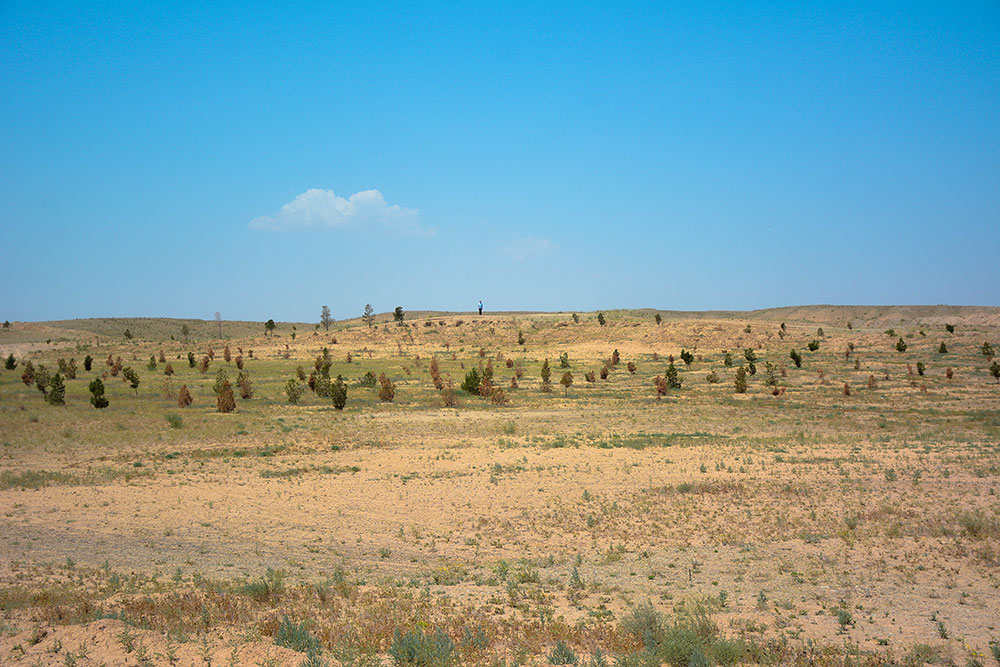
In “Self-Portrait” you repeatedly walk away from the road and re-enter the frame – until the act becomes meditative. At what point did repetition itself become part of the work’s meaning, rather than simply a method?
Initially, repetition was purely practical. I was working by myself, moving into the landscape, choosing where to stop, returning, and then repeating the action again in another place, on another day, while the cameraman mainly captured the moment. But quite quickly I realised that this repetition was no longer separate from the work; it had become part of the work itself. I even started recording short videos on my phone while walking far away, because I could feel that this process was becoming the emotional spine of the piece.
Gradually, the repeated act shifted from a way of making an image into something more connected to duration, attention, and bodily awareness.
It became less about arriving at a single photograph and more about entering a state where body, distance, and landscape could begin to respond to one another, and through that process start to shape the idea of “self.”
In that sense, repetition turned the work into a lived encounter between self, time, environment, and presence.
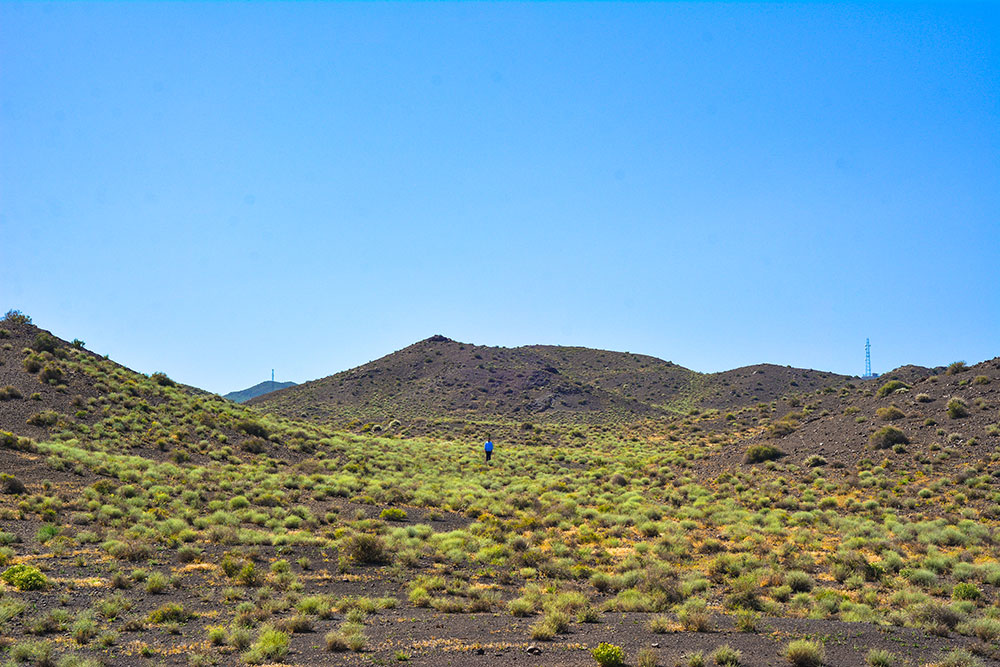
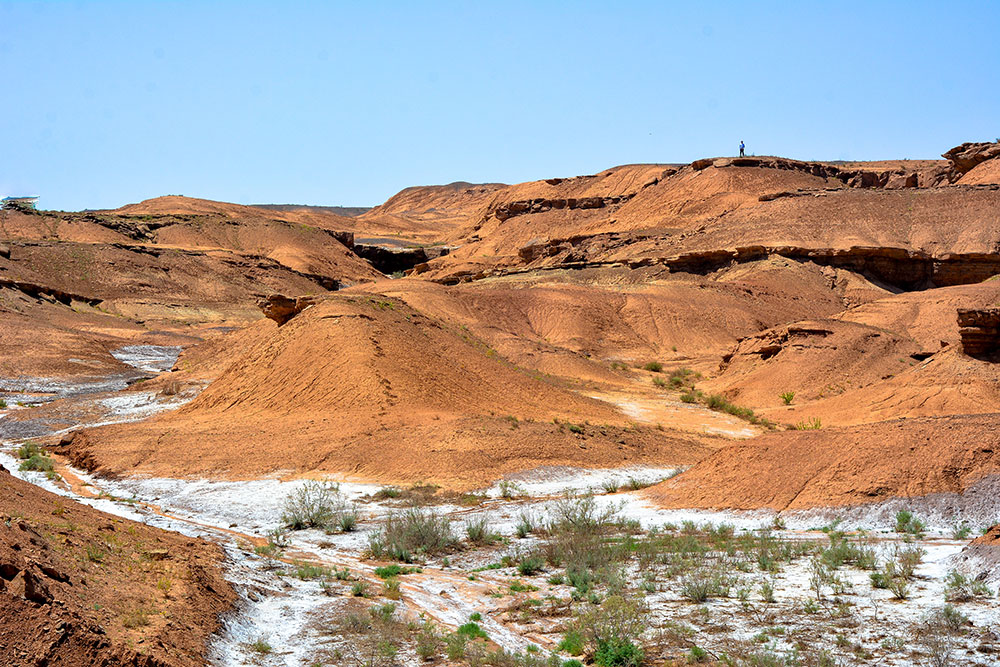
You describe the landscape in “Self-Portrait” as an active collaborator rather than a background. How does that shift in roles change what you are actually looking for when you choose a location along those Iranian highways?
I have always been fascinated by the landscapes beside highways – those bare, open areas that seem to contain almost nothing. But that “nothing” is exactly what makes me stop. For me, they metaphorically reflect a relationship with life itself: a feeling of being lost among the unknown, and of being disconnected from city life and the structures around it. That is what kept pulling me back to them.
In those spaces, I became very aware of my own scale against the horizon. The more I looked, the more that emptiness began to feel immersive, almost as if it was drawing me inward. It felt like the farther I moved into the landscape, the deeper I was moving into a conversation with myself. In that vastness, what first appeared as emptiness slowly revealed something else – not absence, but another way of sensing the self.
So when I chose a location, I was really looking for a place that could do that: not simply frame the body, but challenge it, absorb it, and shape the emotional logic of the image. The landscape became an active collaborator because it helped define what “self” could mean in that moment.
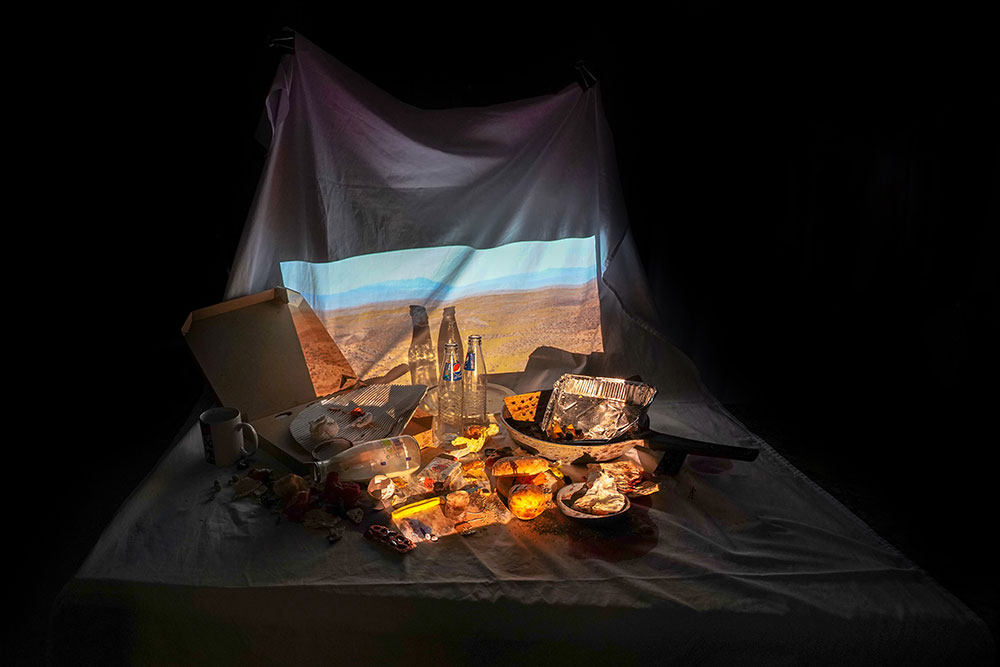
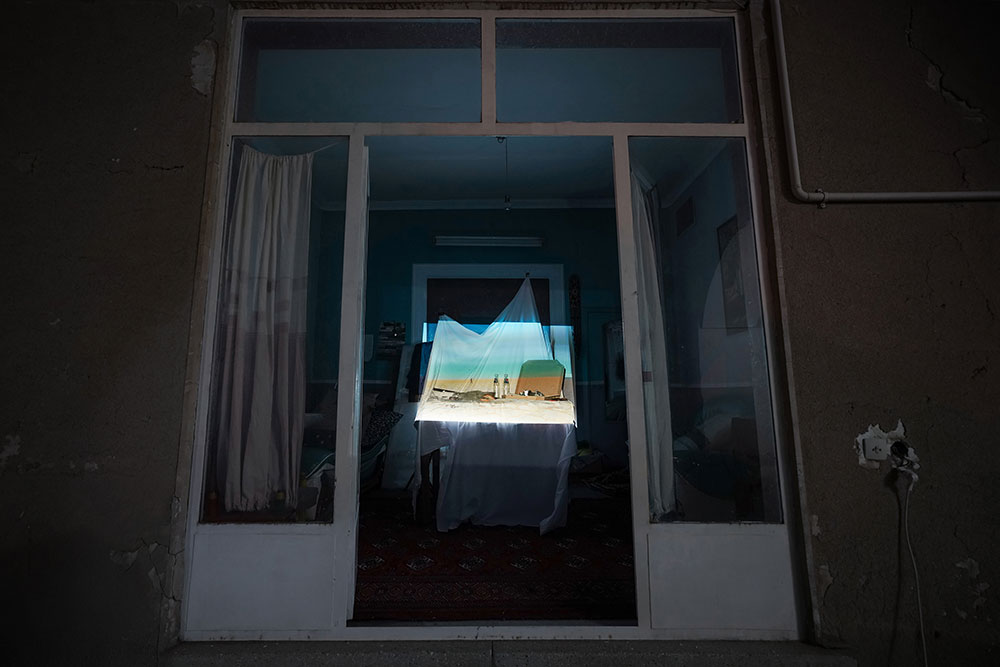
“Still Life, In Motion” takes domestic remnants and transforms them through projection and re-photography. What draws you to objects that already carry a history of use – and what do you want projection to do to that history?
I’ve always been drawn to still life because, in many well-known paintings, it holds a quiet relationship to absence, time, and even death. That was part of my starting point here, too, but I wanted to translate that feeling through domestic garbage, treating it as a form of existence in itself. These objects carry traces of habit, routine, touch, and small acts of living that are usually overlooked. I’m interested in that quiet emotional weight, and in the way ordinary things can hold memory without openly declaring it.
What interests me most is their ambiguity. They make you wonder what happened there: do they belong to one person living alone in a messy space, or are they simply what remains after people have left? As a mixed-media artist, projection allows me to disturb that familiarity without erasing it. It adds another layer – movement, elsewhere, instability, sometimes even longing.
By projecting onto these objects and then re-photographing the scene, I let them hold another image, another space, and another sense of time. The final image becomes a hybrid space.
Your MA at Central Saint Martins came after a BA in Tehran, and your practice is now based in London. How has moving between these contexts shaped what memory and displacement actually mean inside the work – rather than as themes stated about it?
Absolutely, moving between Tehran, London, and other contexts of migration changed the way I think before it changed what my work looked like. Memory and displacement stopped being subjects I could simply speak about; they became part of how I see, edit, and build images and spaces.
I became much more aware of translation, rupture, and how unstable meaning can be. Even small things – objects, gestures, textures, distances – started to carry more emotional weight. That is one reason my practice moves between mediums rather than staying in one. Working in mixed media helps me hold those contradictions more honestly, especially the tensions between presence and absence, nearness and distance, familiarity and rupture.
So for me, displacement is not only a theme; it shapes the form of the work itself, in how elements are brought together, interrupted, layered, or left unresolved.
You work across photography, installation, performance, and mixed media – but in the application you describe a growing intention to bring these into a single immersive atmosphere. What is currently stopping that from happening, and what would it look like when it does?
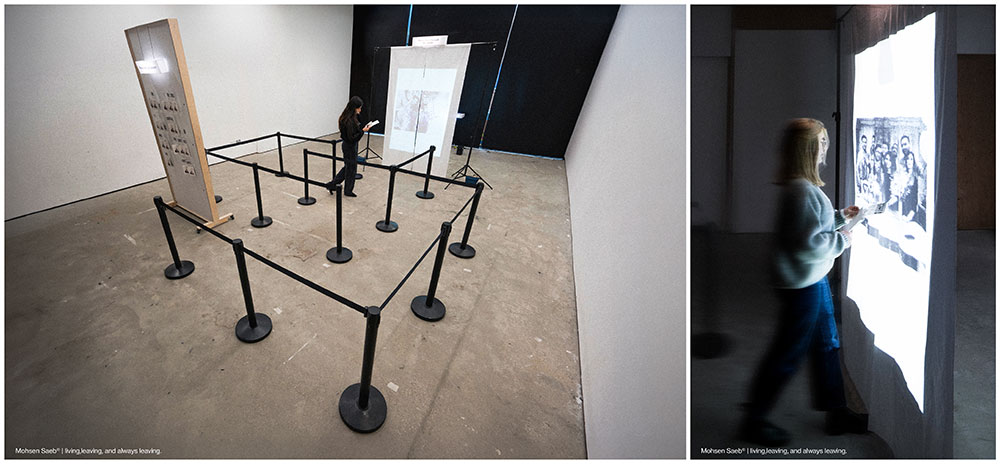
Actually, I’ve already started moving in that direction, and part of that can be seen in Living, Leaving, and Always Leaving (Mohsen Saeb, London, 2024). It was an immersive performance in which I tried to build an emotional connection between the audience and the experience of waiting in airports as an immigrant, that suspended feeling of uncertainty, separation, and transition. So the immersive side of my practice has already begun, but it is still continuing to develop.
Immersive work needs space, time, technical support, and resources. But beyond that, it is also about reaching a clearer understanding of how different elements can live together without competing, and how they can all remain connected to the heart of the story.
I don’t want to combine mediums just to make it more complex. I want each element to feel necessary to the others. I’m moving toward a way of working where photography, moving image, sound, performance, objects, and spatial design come together as one emotional experience. In that kind of work, the viewer would not just observe separate parts, but move through an atmosphere where meaning unfolds gradually through sequence, sensation, and connection.
Immersive work needs space, time, technical support, and resources. But beyond that, it is also about reaching a clearer understanding of how different elements can live together without competing, and how they can all remain connected to the heart of the story.
I don’t want to combine mediums just to make it more complex. I want each element to feel necessary to the others. I’m moving toward a way of working where photography, moving image, sound, performance, objects, and spatial design come together as one emotional experience. In that kind of work, the viewer would not just observe separate parts, but move through an atmosphere where meaning unfolds gradually through sequence, sensation, and connection.
The name “and.Wherever” carries a kind of open-endedness – a sentence that never quite finishes. Was that deliberate, and how does it describe where you see your practice going?
Yes, it was deliberate. I wanted a name that felt open rather than fixed – something that could hold movement, continuation, and the sense that not everything needs to arrive at one clear destination. “and.Wherever” carries that feeling for me. It sounds like a phrase that is still unfolding, and that feels very close to how I understand both life and my artistic practice.
As a mixed-media artist, I don’t see my work moving toward one final form or one stable definition. I’m more interested in following an idea through different materials, spaces, and emotional states, and letting the work grow through that process. The name holds that openness for me. It leaves room for uncertainty, for transition, and for not always knowing in advance where a work might lead.
In that sense, it reflects how I see my practice growing – not in a straight line, but through exploration, layering, and constant change. It is less about arriving somewhere fixed, and more about staying open to what each work asks for emotionally, materially, and spatially.
You mention wanting to build environments where meaning unfolds through experience rather than explanation. Is there a specific work – realised or not yet made – that comes closest to that intention?
The work that comes closest so far is Living, Leaving, and Always Leaving, because it allowed me to bring sequence, movement, object, image, and participation into one shared experience. The audience did not just look at the work; they moved through it physically, passing through stages that carried emotional weight. That was important to me because it shifted the meaning from something simply presented into something personally encountered.
At the same time, I still see that work as part of a larger direction rather than the final form of that intention. It showed me how different elements can begin to work together as one atmosphere, but I know there is still more to develop.
The works I want to make next move further into that space – environments where image, sound, objects, spatial rhythm, and the presence of the body come together more naturally and more fully.